
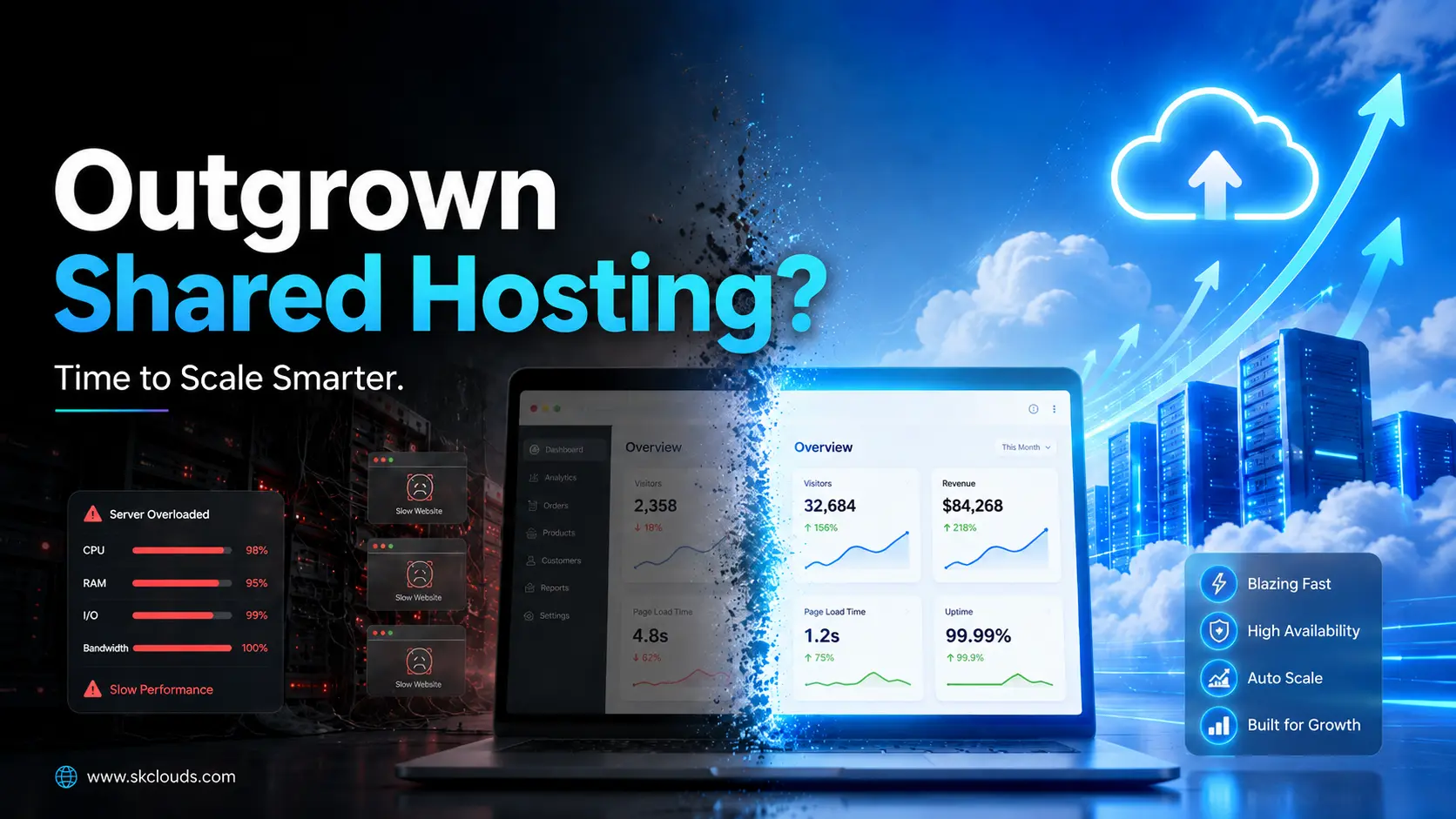
What Happens When Your Website Outgrows Shared Hosting?
Shared hosting is often the right place to start. It is affordable, easy to manage, and works well for small websites with moderate traffic. But as your business grows, your website may start demanding more resources than a shared hosting environment can comfortably provide.
When that happens, staying on the same hosting plan can affect speed, reliability, security, and even customer experience.
So, how do you know when your website has outgrown shared hosting, and what should you do next?
What Is Shared Hosting?
Shared hosting means multiple websites are hosted on the same server and share resources such as CPU, RAM, storage, and bandwidth.
Think of it like living in an apartment building. You have your own space, but some resources are shared with other residents.
For a new business website, portfolio, blog, or small online store, this setup can work perfectly well. However, as traffic and functionality increase, those shared resources can become limiting.
Signs Your Website Has Outgrown Shared Hosting
- Your Website Is Becoming Slower
One of the first warning signs is declining website speed.
As your website receives more visitors, loads more images, runs additional plugins, or processes more database requests, it requires more server resources.
If your shared hosting plan cannot provide enough capacity, pages may begin loading slowly, especially during busy periods.
A slow website can lead to:
- Higher bounce rates
- Lower engagement
- Poorer user experience
- Lost leads and sales
Website performance becomes increasingly important as your online presence grows.
- Traffic Spikes Cause Your Website to Struggle
A successful campaign, viral social media post, product launch, or seasonal sale can suddenly bring hundreds or thousands of visitors to your website.
That is great for business—but your hosting needs to handle it.
On limited shared hosting resources, traffic spikes can result in:
- Slow page loading
- Server errors
- Temporary downtime
- Failed transactions
- Visitors leaving before the website loads
If your website regularly receives unpredictable or growing traffic, it may be time for a hosting environment with greater scalability.
- You Experience Frequent Downtime
Your business website should be available whenever customers need it.
If your website regularly becomes unavailable or displays server-related errors, the problem may not be your website itself. Your hosting environment could be reaching its limits.
Downtime is especially damaging for e-commerce businesses, service providers, and companies that rely on their website to generate enquiries.
Every minute your website is unavailable can mean missed opportunities.
- Your Website Needs More Resources
Modern websites often become more complex over time.
You may start with a simple five-page website and later add:
- Customer dashboards
- Online payments
- Booking systems
- Large databases
- Membership features
- Video content
- E-commerce functionality
- Marketing integrations
- Business applications
Each new feature can increase the amount of server resources your website needs.
Eventually, shared hosting may simply not provide enough CPU, memory, storage, or processing capacity.
- Your E-Commerce Store Is Growing
Growing online stores are particularly sensitive to hosting performance.
Every product search, cart update, login, checkout, inventory query, and payment request requires server processing.
As orders and visitors increase, an underpowered hosting plan may create frustrating delays during the most important part of the customer journey.
For an e-commerce website, upgrading hosting is not just a technical decision. It can directly support better conversion rates and customer satisfaction.
- You Need Greater Security and Control
Shared hosting environments are designed for simplicity.
As your business grows, however, you may want more control over:
- Server configurations
- Security settings
- Backups
- Access permissions
- Software versions
- Resource allocation
- Monitoring
Businesses handling sensitive customer or commercial information may also require stronger security controls than entry-level hosting plans provide.
Moving to a more advanced hosting solution gives businesses greater flexibility to build an infrastructure suited to their requirements.
What Happens If You Don’t Upgrade?
Remaining on an underpowered hosting plan can create problems that become more noticeable as your website grows.
You may experience slower performance, increased downtime, resource-limit warnings, failed processes, and difficulty adding new functionality.
More importantly, customers may experience these problems before you do.
A visitor does not know that your server has reached its resource limit. They simply see a slow or unavailable website—and may move to a competitor instead.
What Should You Upgrade To?
The right option depends on your website’s traffic, application requirements, budget, and expected growth.
VPS Hosting
Virtual Private Server hosting provides dedicated resources within a virtualized server environment.
Compared with standard shared hosting, VPS hosting generally offers better performance, flexibility, and control.
It can be a suitable next step for growing websites that need more resources without requiring an entire dedicated server.
Cloud Hosting
Cloud hosting distributes website resources across cloud infrastructure rather than depending on a single traditional server setup.
It is particularly useful for businesses that need flexibility and the ability to scale resources as demand changes.
For websites experiencing rapid growth or fluctuating traffic, cloud hosting can provide a more scalable foundation.
Dedicated Hosting
With dedicated hosting, an entire server is allocated to your business.
This provides significant control and resources but generally requires a larger budget and more technical management.
It is usually more appropriate for high-traffic websites, demanding applications, or businesses with specific infrastructure requirements.
Managed Hosting
Businesses that do not want to manage server administration themselves can consider managed hosting.
With managed hosting, technical responsibilities such as server maintenance, monitoring, updates, backups, and security may be handled by the hosting provider depending on the selected plan.
This allows businesses to focus more on their website and operations rather than server management.
Don’t Wait Until Your Website Starts Failing
A hosting upgrade should ideally happen before performance problems become serious.
Monitor your website’s growth, traffic, resource consumption, loading speed, and uptime. If you consistently reach the limits of your existing hosting plan, upgrading early can prevent disruptions later.
Your hosting should support your business growth—not become the reason your website cannot keep up.
Build a Hosting Environment Ready for Growth
As your business expands, your website infrastructure needs to evolve with it.
Whether you need better performance, more server resources, stronger reliability, or a scalable cloud environment, choosing the right hosting solution can give your website room to grow.
At SK Clouds, we help businesses find hosting solutions suited to their website requirements and future growth.
Ready to move beyond shared hosting?
Visit www.skclouds.com and explore hosting solutions built to support your growing online presence.
