
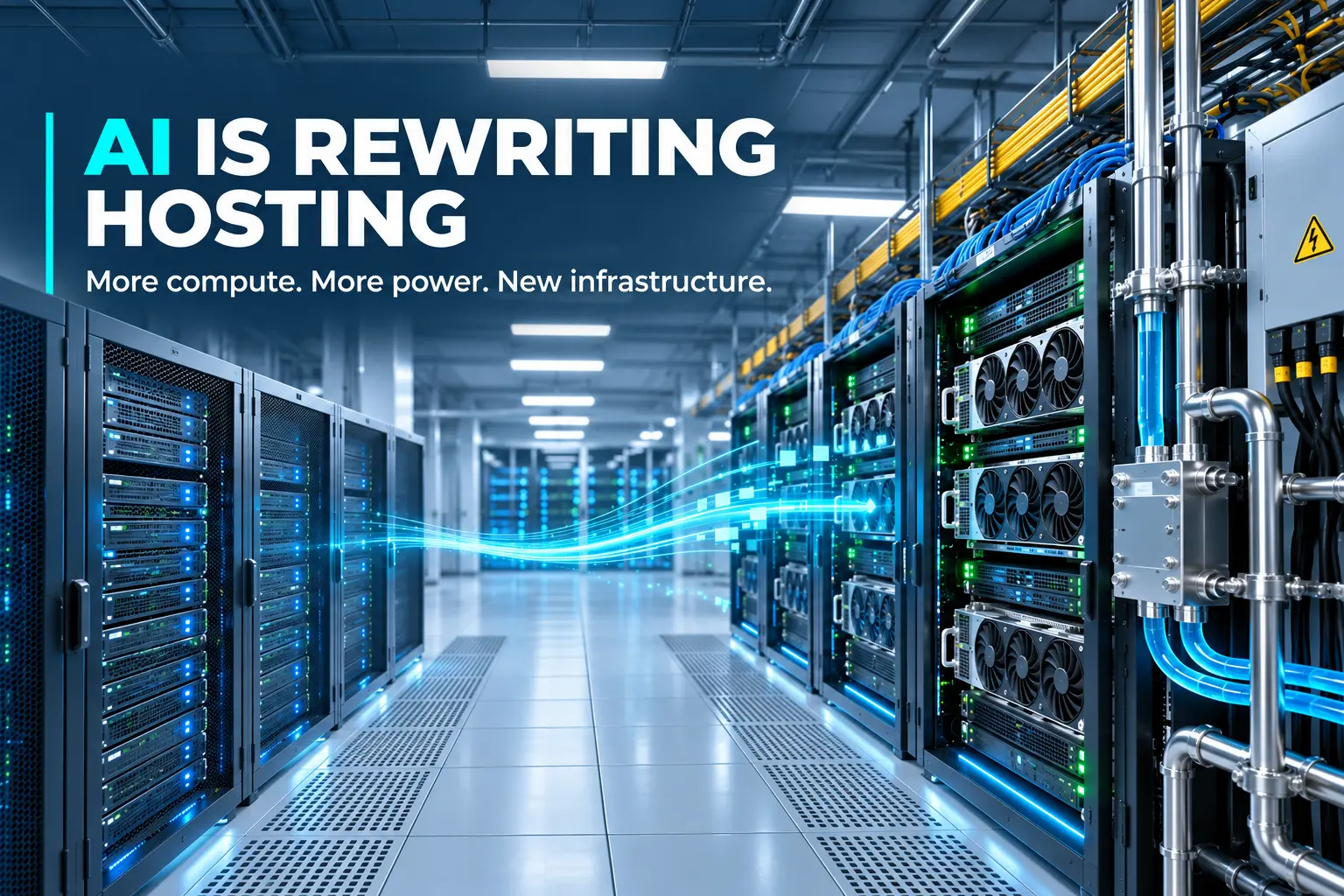
How AI Workloads Are Changing Traditional Hosting Requirements
Artificial Intelligence is transforming how businesses develop and operate digital applications. From AI-powered chatbots and recommendation engines to automated business platforms and generative AI tools, modern applications are becoming more computationally demanding.
Traditionally, hosting requirements focused on website traffic, storage capacity, bandwidth, and server uptime. However, AI-driven applications introduce a different set of infrastructure requirements. They often need higher processing power, specialised hardware, faster data access, and infrastructure capable of handling complex workloads.
As businesses increasingly integrate AI into their digital operations, traditional hosting environments must evolve to support these changing demands.
- AI Applications Require More Computing Power
Traditional websites primarily depend on CPU resources to process user requests, load pages, and manage database operations.
AI workloads can require significantly more computing resources, particularly when applications perform machine learning model training, image generation, video processing, or large-scale data analysis.
Some AI applications also require GPUs (Graphics Processing Units), which are designed to handle multiple calculations simultaneously.
This means hosting providers must offer infrastructure that can support both traditional web applications and computationally intensive AI workloads.
- GPU-Based Hosting Is Becoming More Important
GPUs are playing an increasingly important role in AI infrastructure.
Unlike traditional CPUs, which are designed for a wide range of general-purpose tasks, GPUs can perform many parallel calculations efficiently. This makes them particularly useful for machine learning and deep learning workloads.
Businesses developing AI-powered applications may require GPU-based infrastructure for:
- Training machine learning models.
- Running large language models.
- Processing images and videos.
- Generating AI-based content.
- Performing complex data analysis.
As AI adoption increases, access to specialised GPU infrastructure is becoming an important consideration when selecting hosting environments.
- Memory Requirements Are Increasing
AI applications often require substantial memory resources to process large datasets, load models, and manage simultaneous operations.
For example, running a large language model locally may require significant RAM or GPU memory, depending on the model size and configuration.
Insufficient memory can lead to slower processing, performance limitations, or application failures.
Hosting infrastructure must therefore be planned according to the application’s memory requirements rather than relying only on traditional website hosting specifications.
- Storage Infrastructure Must Handle Larger Datasets
AI systems depend heavily on data. Training datasets, model files, user-generated content, and processing outputs can consume significant storage capacity.
However, storage capacity alone is not enough. AI workloads may also require fast data access to prevent processing bottlenecks.
High-performance SSD and NVMe storage can help improve data access speeds for applications that frequently read and write large amounts of information.
Businesses should evaluate both storage capacity and storage performance when selecting infrastructure for AI applications.
- Network Performance and Bandwidth Matter More
AI applications frequently exchange large volumes of data between users, servers, databases, and external services.
For example, an AI-powered video processing platform may need to upload large video files, process them on specialised infrastructure, and deliver the results back to users.
Network latency and bandwidth limitations can affect the overall application experience.
Hosting environments supporting AI workloads need reliable network connectivity, sufficient bandwidth, and efficient data transfer capabilities.
- Traditional Hosting and AI Hosting Serve Different Requirements
Not every business application requires specialised AI infrastructure.
A standard business website, blog, or company portal can generally operate efficiently on traditional hosting environments.
However, applications involving model training, real-time AI inference, or large-scale data processing may require more advanced infrastructure.
The difference depends on the workload.
For example:
- Traditional website: Requires web server resources, storage, databases, and bandwidth.
- AI chatbot: Requires application hosting, model access, and efficient request processing.
- AI image generation platform: May require GPU resources and substantial memory.
- Machine learning training system: Requires specialised computing resources and high-performance data access.
Understanding these differences helps businesses avoid overpaying for infrastructure they do not need.
- Hosting Scalability Must Adapt to Changing AI Demand
AI workloads are not always predictable. An application may experience increased demand when more users interact with AI-powered features or when large processing tasks are initiated.
Infrastructure must be capable of handling these changes without affecting application performance.
Businesses can use scalable cloud infrastructure, GPU instances, containerisation, and workload management systems to allocate resources according to demand.
This flexibility helps organisations manage infrastructure costs while maintaining application performance.
- Infrastructure Costs Are Becoming More Complex
AI hosting can be more expensive than traditional website hosting because specialised computing resources often come with higher costs.
However, businesses should not automatically choose the most powerful infrastructure available.
The right approach is to evaluate workload requirements and select resources accordingly.
For example, a business using an external AI API may not need its own GPU server. It may only require reliable application hosting to connect users with the AI service.
On the other hand, organisations running their own AI models may need dedicated GPU infrastructure.
Understanding where AI processing happens can help businesses make more cost-effective hosting decisions.
- Security and Data Management Require Greater Attention
AI applications often process business documents, customer information, internal records, and other sensitive data.
This makes infrastructure security an important consideration.
Businesses must implement appropriate access controls, encryption, secure APIs, data backup policies, and network protection.
They should also understand where AI data is processed, how long it is retained, and which external services can access it.
As AI applications become integrated into business operations, hosting infrastructure must support both performance and responsible data management.
Conclusion
AI is changing the expectations placed on hosting infrastructure. Traditional requirements such as storage, bandwidth, and server availability remain important, but modern AI applications also demand specialised computing power, higher memory capacity, faster storage, and efficient network performance.
However, not every AI-powered application needs expensive GPU infrastructure. Hosting requirements should depend on whether the application uses external AI services, performs local inference, or trains its own models.
For businesses planning to integrate AI into their digital platforms, choosing the right infrastructure is becoming an important part of long-term technology planning.
At SK Clouds, we understand the importance of reliable hosting, server performance, and scalable infrastructure. As application requirements evolve, businesses need hosting solutions that can support their digital growth and changing technology needs.
Explore our hosting solutions at www.skclouds.com
