
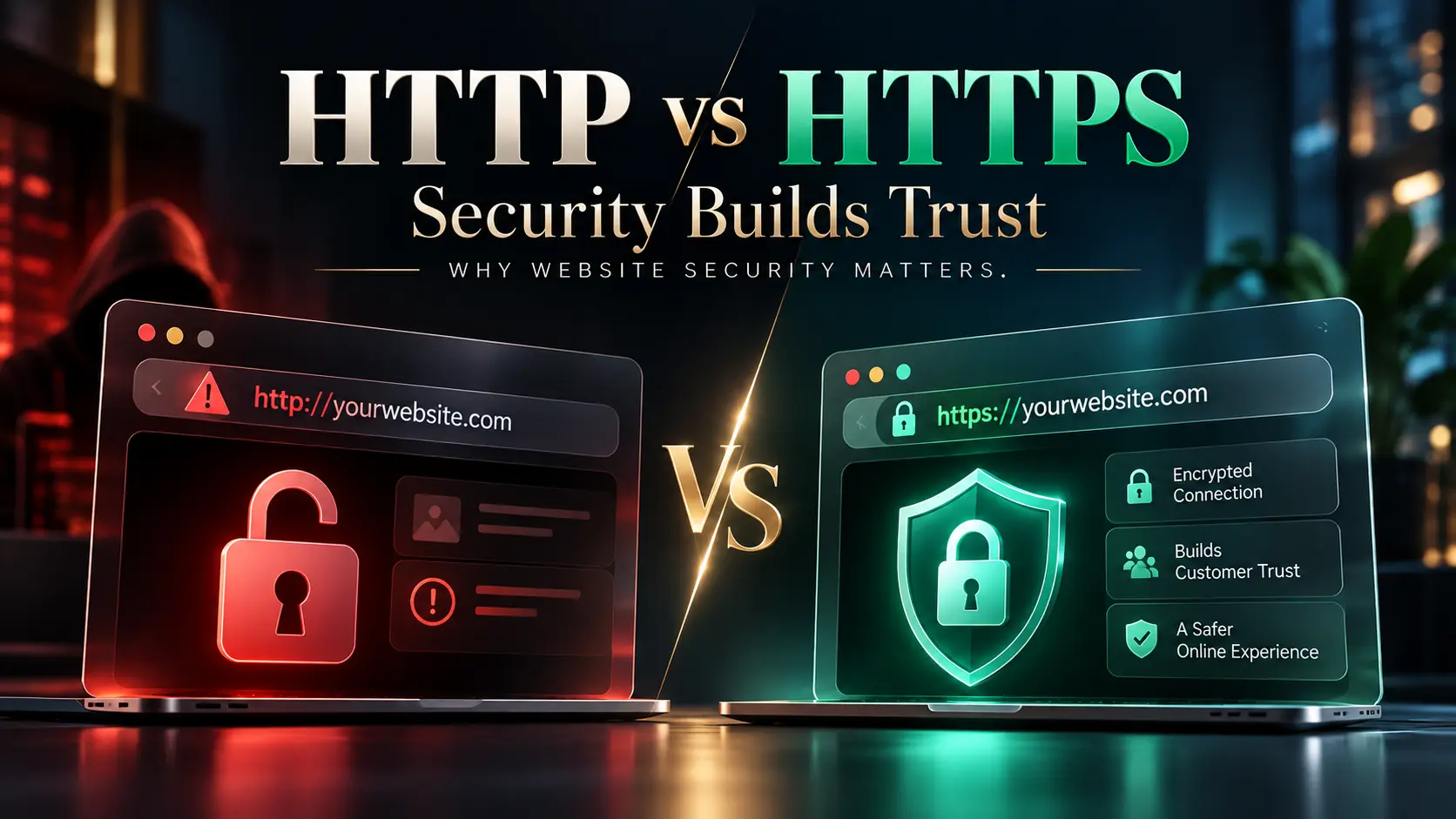
HTTP vs HTTPS: Why Website Security Matters
Website security is no longer optional. Whether you run a business website, an online store, a blog, or a customer portal, visitors expect their information to remain secure whenever they interact with your site.
One of the most basic — and important — website security measures is HTTPS.
You may have noticed that some website addresses begin with http://, while others begin with https://. That extra “S” represents a major difference in how information is transferred between a website and its visitors.
What Is HTTP?
HTTP, or Hypertext Transfer Protocol, is the standard method used to transfer information between a web browser and a website server.
When a website uses HTTP, the information exchanged between the user and the website is generally transmitted without encryption.
This means that data such as:
- Login credentials
- Contact form information
- Personal details
- Payment-related information
may be more vulnerable to interception if additional security measures are not in place.
What Is HTTPS?
HTTPS stands for Hypertext Transfer Protocol Secure.
It works similarly to HTTP, but adds an important layer of protection through an SSL/TLS certificate.
HTTPS encrypts the communication between the visitor’s browser and the website server, making it significantly more difficult for unauthorized parties to read or modify the information being transferred.
When HTTPS is properly configured, browsers typically display a secure connection indicator beside the website address.
HTTP vs HTTPS: What Is the Difference?
The main difference between HTTP and HTTPS is encryption and security.
HTTP transfers information without the same encrypted connection provided by HTTPS, while HTTPS uses SSL/TLS encryption to protect data during transmission.
For businesses, this difference is important because websites frequently collect information through enquiry forms, account registrations, login pages, payment systems, booking platforms, and other online interactions.
Why HTTPS Matters for Your Website
- Protects Visitor Data
HTTPS encrypts information exchanged between your website and its visitors.
This is particularly important if your website collects names, phone numbers, email addresses, passwords, payment information, or other sensitive details.
Even websites that only contain contact forms can benefit from encrypted communication.
- Builds Customer Trust
Visitors are increasingly aware of website security.
When a browser indicates that a website connection is secure, users are generally more comfortable browsing the site, submitting forms, registering accounts, or completing purchases.
On the other hand, browser security warnings can cause potential customers to leave before interacting with your website.
- Helps Protect Login Credentials
Websites with customer accounts, administrator dashboards, employee portals, or membership systems often handle usernames and passwords.
Using HTTPS helps protect these credentials while they travel between the browser and the server.
Without encryption, sensitive information can face greater exposure on compromised or insecure networks.
- Supports SEO
HTTPS has also become an important technical element of modern SEO.
Search engines expect websites to provide secure browsing experiences, and HTTPS has long been considered a positive ranking signal.
However, HTTPS alone will not automatically improve rankings. Strong SEO still depends on content quality, website performance, mobile usability, technical optimisation, backlinks, and overall user experience.
HTTPS should therefore be viewed as an essential foundation rather than a complete SEO strategy.
- Essential for E-Commerce Websites
For online stores, HTTPS is especially important.
Customers may enter information such as:
- Billing details
- Shipping addresses
- Account passwords
- Personal information
- Payment-related data
A secure connection helps protect this information and gives customers greater confidence when completing transactions.
- Prevents Data Tampering
Encryption does more than protect information from being read.
HTTPS also helps protect the integrity of data travelling between the website server and the visitor’s browser.
This reduces the risk of information being modified while it is being transmitted.
- Supports Modern Website Features
Many modern browser technologies and web services expect or require secure HTTPS connections.
Using HTTPS therefore helps ensure better compatibility with modern websites, APIs, progressive web applications, authentication systems, and other digital services.
What Is an SSL Certificate?
An SSL certificate is a digital certificate that helps establish an encrypted connection between a website server and the visitor’s browser.
Although modern encryption technically relies on TLS, the term SSL certificate is still widely used in the hosting industry.
Once installed and configured correctly, the certificate allows your website to use HTTPS.
SSL certificates can be free or paid depending on the hosting provider, certificate type, warranty, validation requirements, and support level.
Is HTTPS Enough to Keep a Website Secure?
No.
HTTPS protects information while it is being transmitted, but complete website security requires additional measures.
Businesses should also consider:
- Regular website backups
- Strong passwords
- Multi-factor authentication
- Updated CMS software
- Updated plugins and themes
- Malware scanning
- Firewall protection
- Secure hosting infrastructure
- Restricted administrator access
- Regular security monitoring
HTTPS should be considered one important layer within a broader website security strategy.
How to Check Whether Your Website Uses HTTPS
Checking your website is simple.
Open your website in a browser and look at the address bar.
If the website address begins with:
https://
your website is using HTTPS.
You can also check the browser’s site information or security indicator to confirm whether the SSL/TLS certificate is valid.
If the browser displays a certificate warning, “Not Secure” message, or connection error, your certificate may be expired, incorrectly installed, or misconfigured.
Moving From HTTP to HTTPS
If your website still uses HTTP, migrating to HTTPS should be a priority.
The process usually involves:
- Obtaining an SSL certificate.
- Installing the certificate on the hosting server.
- Updating the website to load resources through HTTPS.
- Redirecting HTTP URLs to HTTPS.
- Updating internal links.
- Updating canonical URLs and sitemaps.
- Checking Google Search Console and analytics configurations.
- Testing the website for mixed-content errors.
Incorrect HTTPS migration can create redirect issues, broken images, duplicate URLs, or SEO problems, so proper implementation is important.
Final Thoughts
HTTPS has become a standard requirement for modern websites.
It helps protect visitor information, improves trust, supports technical SEO, enables secure online transactions, and provides a stronger foundation for website security.
If your website is still running on HTTP, upgrading to HTTPS is one of the most important improvements you can make.
With reliable hosting, SSL protection, regular updates, backups, and proper security monitoring, businesses can provide visitors with a safer and more professional online experience.
